


Captcha solver browser extensions
This plugins allows you to automatically solve and bypass captchas found on any webpage.
Add to browser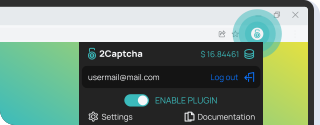
 To home page
Anti-bot headless browser for AI agents and advanced scraping.
Browser fingerprints data for automation
Access protected pages for web scraping
Automation software that has already integrated our service
Service updates and new features
Tutorials, samples, and guides
Sample forms with captcha demo

Browse GitHub repository for SDKs, code samples, and ready-to-use integration examples
This solving service is currently unavailable or under development. We apologize for any inconvenience. However, if you have a high volume of tasks, we can offer a custom solution—please contact us via the feedback form.
Contact sales

 +973 3402 2155
 t.me/captchasupport_bot
 support@2captcha.com
 +1 (716) 486-3133
This plugins allows you to automatically solve and bypass captchas found on any webpage.
Add to browser
Akamai functions as a global reverse proxy based on Anycast, terminating TLS connections at edge servers. At the application layer (L7), its built-in WAF inspects HTTP headers and payloads, applying signature-based analysis and anomaly scoring. In parallel, Bot Manager dynamically injects obfuscated JavaScript code to collect client-side telemetry (sensor data), including browser fingerprinting, WebGL parameters, TLS fingerprint properties (JA3), and input behavioral patterns. Based on these multidimensional metrics, a cryptographic validation token is generated; requests lacking a valid token or exhibiting a low trust score are dropped at the edge server level or redirected to complete a captcha before reaching the target backend.

Akamai functions as a global reverse proxy based on Anycast, terminating TLS connections at edge servers. At the application layer (L7), its built-in WAF inspects HTTP headers and payloads, applying signature-based analysis and anomaly scoring. In parallel, Bot Manager dynamically injects obfuscated JavaScript code to collect client-side telemetry (sensor data), including browser fingerprinting, WebGL parameters, TLS fingerprint properties (JA3), and input behavioral patterns. Based on these multidimensional metrics, a cryptographic validation token is generated; requests lacking a valid token or exhibiting a low trust score are dropped at the edge server level or redirected to complete a captcha before reaching the target backend.
Akamai obstructs traffic from automated bots, posing challenges for accessibility and testing.
Developers and QA engineers require stable tools to automate routine tasks and validate system integrity.
Seamless testing of user flows (registration, checkout) in CI/CD pipelines using headless browsers (Puppeteer, Playwright) without facing roadblocks in pre-production environments.
Infrastructure resilience validation. Helps cybersecurity professionals (pentesters) emulate complex traffic scenarios and test the response of bot protection systems (e.g., Akamai or Imperva) under heavy load.
Legitimate public data gathering to scale business processes and empower analytics.
Extracting competitors' public pricing for dynamic pricing strategies, as well as aggregating data for real estate or flight search platforms.
Bulk metadata extraction and search engine rank tracking. A reliable tool for conducting large-scale SEO audits without the risk of IP blocks.
Automated collection of large, open-source datasets for investigative journalism or training machine learning (ML) models.
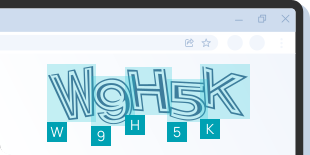
Optical character recognition combined with human intelligence (Human-in-the-loop) for complex, non-standard tasks.
Accounting automation, receipt recognition for loyalty (cashback) programs, and rapid invoice digitization for logistics companies.
Converting handwritten data, forms, and scanned archives into digital formats when traditional OCR algorithms fail due to poor source image quality.
Manual dataset labeling for neural network training and human moderation of user-generated content (UGC) for restricted materials.
Building an inclusive internet and assisting users with special needs.
Automated captcha solving using machine learning and human-in-the-loop technologies. Assists users who face difficulties with the visual or cognitive demands of standard security systems.
We’ve made it easy to integrate our products into your system, offering a quick and easy start to your web project with support for multiple programming languages and ready-to-use code examples.
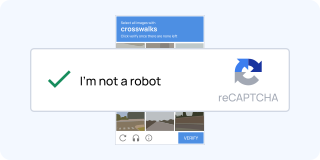
The process of solving reCAPTCHA v2 is as follows: we take the captcha parameters from the page in the form of the data-sitekey parameter and the page URL and transfer it to the 2Captcha service, where the employee solves it, then the response is returned to us in the form of a token, which must be entered into the appropriate field for the solution captcha
API demoHow to solveThe process of solving reCAPTCHA v2 Callback does not differ from the similar process of solving reCAPTCHA v2: we take the captcha parameters from the page in the form of the data-sitekey parameter and the page URL and transfer it to the 2Captcha service, where the employee solves it, then the response is returned to us in as a token, which we should be entered into the appropriate field to solve the captcha. Sometimes you won't find a button submitting a form. A callback function can be used instead. This function is executed when the captcha is recognized. Usually the callback function is defined in the data-callback parameter or as the callback parameter of the grecaptcha.render method call
API demoHow to solve
The process of solving reCAPTCHA v2 Invisible is similar to the recognition of reCAPTCHA v2: we take the captcha parameters from the page in the form of the data-sitekey parameter and the page URL and transfer it to the 2Captcha service, where the employee solves it, after which the response is returned to us in the form of a token, which we need enter in the appropriate field to solve the captcha
API demoHow to solve
The process of solving a image captcha is as follows: we take the captcha image from the page and send it to the 2Captcha service, where an employee solves it typing the indicated text, then the answer is returned to us, which must be entered in the appropriate field to solve the captcha
API demoHow to solve
Cloudflare Turnstile is solved by taking the captcha parameters from the page in the form of the "data-sitekey" parameter and the page URL, sending them to the 2Captcha service, where an employee solves them. The solution is then returned to us in the form of a token, which we must enter in the relevant field to complete the captcha.
API demoHow to solve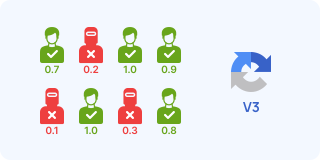
The process for solving reCAPTCHA v3 is as follows: we take the captcha parameters from the page in the form of the data-sitekey, action and the page URL and transfer it to the 2Captcha service, where it is solved by an employee with the appropriate "humanity” rating, after that the response is returned to us in the form of a token, which must be entered into the appropriate field to solve the captcha. In many ways, the new type of captcha is similar to reCAPTCHA v2, i.e. the basic principle remains the same - the user receives a token from the 2Captcha API, which is sent in a POST request to the site, and the site verifies the token through the 2Captcha API
API demoHow to solve
The process of solving reCAPTCHA Enterprise is as follows: we determine the type of reCAPTCHA, it can be v2 or v3, after which we take the captcha image from the page of its placement in the form of the data-sitekey parameter and transfer it to the 2Captcha service, where it is solved by the employee, after which it is returned to us answer in the form of a token, which must be entered in the appropriate field to solve the captcha
API demoHow to solve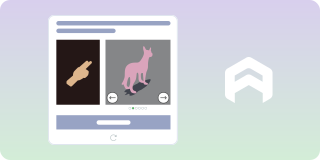
The process of solving FunCaptcha by Arkose Labs is as follows: we take a set of necessary parameters from the page of its placement and transfer it to the 2Captcha service, where the employee solves it, after which the answer is returned to us in the form of a set of already other parameters, which must be passed to the appropriate fields to solve the captcha
How to solve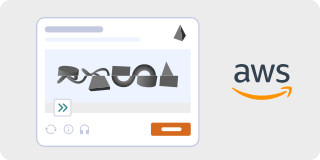
The procedure for solving a Amazon AWS captcha is as follows: you need to grab the set of required parameters from the placement page and send it to the service, where an employees solves task. The answer is then returned to us in the form of a set of additional parameters, which must be entered into the correct fields to solve.
How to solve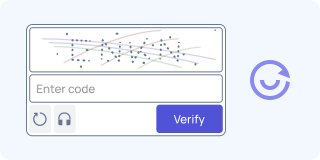
The automatic recognition of ALTCHA occurs in the following sequence: our service retrieves the captcha code from the specified website’s page and sends it to a worker for solving. We then return the answer to you, which you input into the captcha solution field. A key feature of this captcha is that it is designed as a slider, making it difficult for bots to bypass.
How to solve