



Launched a Browser API for web scraping, automation, and AI agents

Tech builder focused on infrastructure, automation, backend systems, and scalable SaaS development
Launched a 2Captcha Scraping Browser API for web scraping, automation, and AI agents
Collecting data from websites often requires a full browser environment: JavaScript rendering, cookies, sessions, proxies, fingerprints, clicks, scrolling, waiting for elements, and handling captcha checks. A simple HTTP request is no longer enough for many real-world workflows, while maintaining your own fleet of headless browsers quickly becomes a separate infrastructure challenge.
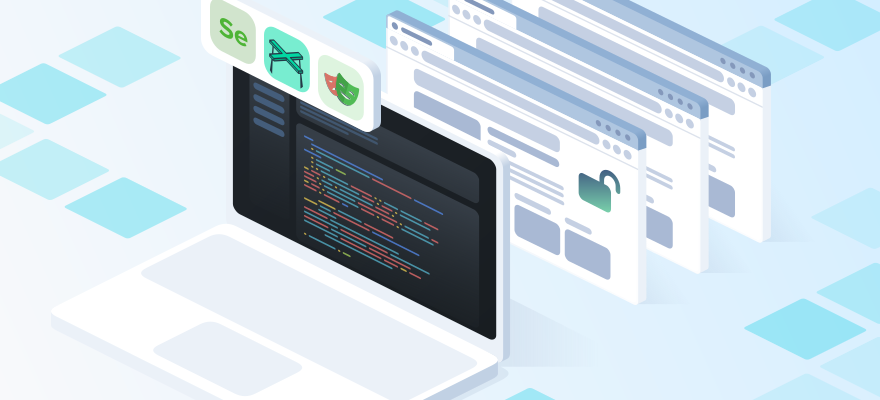
2Captcha Scraping Browser solves this problem as a managed 2Captcha Scraping Browser API environment. You write a workflow in Puppeteer, Playwright connect it to a remote browser endpoint instead of launching Chrome locally, and the service handles browser execution, the network layer, sessions, JavaScript rendering, access checks, scaling, and debugging.
Briefly: what this product is
2Captcha Scraping Browser is a managed 2Captcha Scraping Browser API for web scraping, data extraction, browser automation, and AI agents. It lets you run real browser sessions in the cloud and control them from code through CDP, WebSocket, Puppeteer, Playwright.
API link: Browser API.
Service link: open dashboard.
Instead of running Chrome on your own servers, maintaining Docker images, tracking browser versions, and wiring proxies, cookies, sessions, and fingerprints yourself, you connect your script to a remote browser endpoint. The script keeps the same logic: open a page, click an element, enter text, wait for a selector, scroll, capture HTML, take a screenshot, read network responses, or extract structured data.
2Captcha Scraping Browser is not a replacement for Puppeteer, Playwright. It is the environment where these tools can run at scale, with browser execution, networking, debugging, and infrastructure handled outside your own servers.
Who 2Captcha Scraping Browser API is built for
2Captcha Scraping Browser is built for teams that already use browser automation and for teams that are outgrowing simple HTTP-based scraping.
Developers can run Puppeteer, Playwright without maintaining Chrome servers. Data engineers can collect data from JavaScript-heavy websites, marketplaces, catalogs, search results, and public web interfaces. QA teams can run E2E checks in isolated browser sessions. AI and LLM teams can give agents a real browser for opening websites, interacting with pages, and collecting fresh context.
The product becomes relevant when a single local headless browser is no longer enough. That usually means parallel sessions, stable proxies, persistent sessions, retries, debugging tools, and a clear view of what the browser actually sees.
How to use 2Captcha Scraping Browser API
Using 2Captcha Scraping Browser API is based on three main steps: create a browser account, create as many cloud browser profiles as you need, and connect to those profiles through a proxy.
1. Create a browser account
First, create a browser account. It gives you access to the 2Captcha cloud browser infrastructure and stores the basic connection settings.
The browser account is the entry point for the product. It is used to create profiles, configure proxies, and generate connection details for Puppeteer, Playwright.
2. Create cloud browser profiles
After creating a browser account, create the cloud browser profiles you need. The number of profiles depends on your use case: you can use a separate profile for each website, account, region, automation scenario, or group of similar tasks.
A profile stores the browser environment, cookies, session settings, and other data required for repeat runs. This means your automation does not have to start from a clean browser every time and can keep session context between launches.
3. Configure a proxy
A proxy is required to use the cloud browser. There are several options:
- Your own proxy — connect your own proxy and use Browser API completely free of charge.
- Free IPv6 proxy — if you do not buy 2Captcha Proxy, the service provides a free IPv6 proxy.
- Paid 2Captcha Proxy — buy proxies inside the service and choose the proxy type that fits your task.
A proxy can be configured at the browser account level, browser profile level, or passed directly in the connection URL.
4. Connect to the selected profile
After the profile and proxy are configured, connect to the selected cloud browser profile through the remote browser endpoint. From there, your automation works with it like with a regular browser: it can open pages, click elements, fill forms, work with cookies, collect data, take screenshots, and run browser automation scenarios.
In practice, your local code controls a cloud browser, while 2Captcha handles browser launch, profile storage, proxy usage, anti-detect settings, fingerprints, captcha handling, and the infrastructure layer.
Key advantages compared to competitors
The main advantages of 2Captcha Scraping Browser API are browser profiles, custom proxy support, built-in fingerprints, and captcha handling inside the browser workflow.
2Captcha Scraping Browser API is different from standard scraping APIs, local headless browsers, and standalone hosted browser solutions because it brings the entire browser layer into one product: a real browser, proxies, geo-targeting, anti-detect capabilities, fingerprints, sessions, captcha handling, scaling, and debugging.
| Feature | 2Captcha Scraping Browser API | Standard scraping API | Local headless Chrome |
|---|---|---|---|
| Browser profiles | Built-in browser profiles | No | Must be implemented manually |
| Custom proxies | Supported at the account, profile, or connection URL level | Separate setup | Manual configuration |
| Anti-detect and fingerprints | Built-in browser layer | No | Manual configuration |
| Captcha | Inside the browser workflow | Separate integration | Separate integration |
| Real browser | Yes | Limited | Yes |
| JavaScript rendering | Yes | Partial | Yes |
| Clicks, scrolling, forms | Yes | Limited | Yes |
| Persistent sessions | Yes | Limited | Must be implemented manually |
| Proxies and geo-targeting | Built in | Separate setup | Separate setup |
| Scaling | Managed | Limited | Must be built manually |
| Debugging | Logs, screenshots, Live Browser View, HAR | Basic | Partial |
Real browser
Unlike a standard HTTP-based API, 2Captcha Scraping Browser API runs a full browser session. Your script can click, scroll, inspect elements, enter data, work with cookies, and track network responses.
This matters for websites that rely on JavaScript, SPA architecture, lazy loading, filters, authentication, modal windows, and dynamic data loading.
Browser profiles
2Captcha Scraping Browser API supports browser profiles. A profile stores the browser environment, cookies, session settings, and other data needed for repeat automation runs.
This is useful when every run should not start from a clean browser: logged-in sessions, user dashboards, recurring checks, monitoring, QA scenarios, and websites that take session history into account.
Scaling
When running browsers locally, customers have to manage instances, queues, Docker, memory limits, restarts, monitoring, and browser updates.
2Captcha Browser API moves these tasks into managed cloud infrastructure. The developer connects to a remote browser endpoint, while the service handles browser launch, isolation, shutdown, and session scaling.
Proxies and geo-targeting
Proxies work as part of the service.
This is useful for e-commerce, SERP tracking, localized website versions, price intelligence, and other tasks where the result depends on the IP address.
Custom proxies
2Captcha Scraping Browser API supports both built-in proxies and customer-owned custom proxies. A proxy can be configured at the browser account level, browser profile level, or passed directly in the connection URL.
This gives teams more flexibility: they can use the 2Captcha proxy infrastructure, connect their own proxies, or separate proxy logic across different profiles and automation scenarios.
Anti-detect and fingerprints
Modern websites do not rely only on the IP address. They may analyze the user agent, viewport, timezone, language, platform, WebGL, Canvas, fonts, WebRTC, TLS fingerprint, HTTP headers, navigator properties, and signs of headless automation.
2Captcha Scraping Browser API works as an anti-detect layer for browser automation. It helps keep the browser environment consistent, so IP address, geolocation, timezone, language, browser settings, and technical fingerprint signals do not conflict with each other.
Fingerprints are part of the browser layer, so developers do not have to manually collect, tune, and synchronize dozens of browser parameters to make the environment look consistent.
You can check the quality of the browser environment with real fingerprint and bot-detection tests:
- BrowserLeaks — WebRTC, Canvas, WebGL, fonts, TLS, HTTP/2, Client Hints, and other browser leak checks.
- CreepJS — advanced browser fingerprinting, privacy leaks, and anti-fingerprinting signals.
- Pixelscan — fingerprint, IP/proxy, DNS leaks, WebRTC, and bot-detection checks.
- SannySoft bot test — basic checks for headless and browser automation signals.
- Incolumitas bot detection tests — headless Chrome, HTTP headers, TLS, Canvas, WebGL, browser fingerprint, and behavioral bot checks.
- BrowserScan bot detection — WebDriver, CDP, navigator, Headless Chrome, and other automation signals.
Captcha handling
Captcha often becomes a separate engineering problem. When running a browser locally, developers have to detect the challenge, connect a captcha-solving service, pass the task data, receive the result, and return it to the automation flow. 2Captcha Scraping Browser API helps handle captchas inside the same browser workflow.
This is one of the key differences from a regular headless browser: captcha handling is built into the browser automation flow instead of being managed as a separate manual integration layer.
Pricing
Browser API is essentially free for customers. A self-managed setup requires spending on proxies, development, monitoring, debugging, browser updates, and support for unstable automation scenarios.
Customers get a ready-to-use browser layer and can focus on scenarios, data, and business logic instead of maintaining Chrome infrastructure.
Why a regular HTTP request is no longer enough
For older or mostly static websites, an HTTP request and an HTML parser can still be enough. A script requests a page, parses the response, extracts the data, and moves on.
Modern websites often work differently. Prices, filters, product cards, reviews, pagination, account pages, maps, search results, and SPA interfaces are frequently rendered by JavaScript. Some data arrives through XHR requests. Some appears only after a click, scroll, location change, filter selection, or form interaction.
That adds real engineering overhead:
- local Chrome instances consume CPU and RAM;
- Docker images and browser grids need maintenance;
- Chrome, driver, and library versions can drift apart;
- long-running processes can hang or leak resources;
- proxies, IP rotation, geo-targeting, and sticky sessions need separate setup;
- cookies, local storage, and persistent sessions need to be saved and reused;
- captcha and access checks add more failure points;
- AI agents need a real browser, not just an HTTP client.
At that point, web scraping and automation stop being only a scripting task. The browser itself becomes infrastructure. 2Captcha Scraping Browser is designed to take over that part.
Why local Chrome becomes a problem
Running one headless browser locally is easy. Running many of them reliably is not.
Each browser session uses memory and CPU. Over time, processes may hang, tabs may remain open, contexts may not close, cache may grow, and Docker containers may behave unpredictably. The team then has to maintain queues, workers, restarts, memory limits, monitoring, load balancing, log collection, and crash recovery.
That work does not improve the scraping logic or the automation scenario. It only keeps the browser fleet alive.
2Captcha Scraping Browser moves this responsibility to a managed environment. Browser sessions are created in the cloud, isolated from each other, and allocated on demand. The developer works with a remote endpoint instead of maintaining a fleet of Chrome instances.
How 2Captcha Scraping Browser works
2Captcha Scraping Browser API works as a remote browser environment. You write a script in the automation tool you already use, but instead of launching Chrome locally, you connect it to a cloud endpoint. After that, the script runs as usual: it opens a page, clicks, waits for elements, scrolls, and extracts data.
Your automation logic stays in your code. Browser execution moves to the cloud. Puppeteer, Playwright still control the page, while 2Captcha Scraping Browser API handles the browser environment, network layer, sessions, fingerprints, JavaScript rendering, captcha handling, retries, and scaling.
For production work, this removes a common operational burden: Chrome servers, stuck processes, driver updates, browser grids, and manual scaling for parallel sessions.
Integrations
Puppeteer
language
import puppeteer from 'puppeteer';

// Connection parameters
const login      = 'browser_login';
const countryCode = 'us';
const password    = 'browser_password';

// Proxy settings
const proxyProtocol = 'http';
const proxyHost     = 'proxy.example.com';
const proxyPort     = '3128';
const proxyLogin    = 'proxy_login';
const proxyPassword = 'proxy_password';

// Generate profile ID
const chars     = 'abcdefghijklmnopqrstuvwxyz0123456789';
const profileId = 'profile_' + Array.from(crypto.getRandomValues(new Uint8Array(5)))
  .map(b => chars[b % 36]).join('');

// Build CDP URL
const proxyUrl = `${proxyProtocol}://${proxyLogin}:${proxyPassword}@${proxyHost}:${proxyPort}`;
const encoded  = btoa(proxyUrl).replace(/\+/g, '-').replace(/\//g, '_').replace(/=+$/, '');
const cdpUrl   = `ws://${login}-pid-${profileId}-zone-scraping_browser-country-${countryCode}-proxy-${encoded}:${password}@cb.2captcha.com:9222`;

(async () => {
  try {
    const browser = await puppeteer.connect({ browserWSEndpoint: cdpUrl });
    const page    = await browser.newPage();
    await page.goto('https://2captcha.com');
    console.log('Title:', await page.title());
    await browser.disconnect();
  } catch (err) {
    console.error('Error:', err.message);
  }
})();
Playwright (Node.js)
language
import { chromium } from 'playwright';

// Connection parameters
const login      = 'browser_login';
const countryCode = 'us';
const password    = 'browser_password';

// Proxy settings
const proxyProtocol = 'http';
const proxyHost     = 'proxy.example.com';
const proxyPort     = '3128';
const proxyLogin    = 'proxy_login';
const proxyPassword = 'proxy_password';

// Generate profile ID
const chars     = 'abcdefghijklmnopqrstuvwxyz0123456789';
const profileId = 'profile_' + Array.from(crypto.getRandomValues(new Uint8Array(5)))
  .map(b => chars[b % 36]).join('');

// Build CDP URL
const proxyUrl = `${proxyProtocol}://${proxyLogin}:${proxyPassword}@${proxyHost}:${proxyPort}`;
const encoded  = btoa(proxyUrl).replace(/\+/g, '-').replace(/\//g, '_').replace(/=+$/, '');
const cdpUrl   = `ws://${login}-pid-${profileId}-zone-scraping_browser-country-${countryCode}-proxy-${encoded}:${password}@cb.2captcha.com:9222`;

(async () => {
  try {
    const browser = await chromium.connectOverCDP(cdpUrl);
    const context = browser.contexts()[0];
    const page    = await context.newPage();
    await page.goto('https://2captcha.com');
    console.log('Title:', await page.title());
    await browser.close();
  } catch (err) {
    console.error('Error:', err.message);
  }
})();
Playwright (Python)
language
import base64
import random
import string
from playwright.sync_api import sync_playwright

# Connection parameters
user_id      = 'browser_login'
country_code = 'us'
password     = 'browser_password'

# Proxy settings
proxy_protocol = 'http'
proxy_host     = 'proxy.example.com'
proxy_port     = '3128'
proxy_login    = 'proxy_login'
proxy_password = 'proxy_password'

# Generate profile ID
chars      = string.ascii_lowercase + string.digits
profile_id = 'profile_' + ''.join(random.choices(chars, k=5))

# Build CDP URL
proxy_url = f'{proxy_protocol}://{proxy_login}:{proxy_password}@{proxy_host}:{proxy_port}'
encoded   = base64.urlsafe_b64encode(proxy_url.encode()).decode().rstrip('=')
cdp_url   = f'ws://{user_id}-pid-{profile_id}-zone-scraping_browser-country-{country_code}-proxy-{encoded}:{password}@cb.2captcha.com:9222'

try:
    with sync_playwright() as p:
        browser = p.chromium.connect_over_cdp(cdp_url)
        context = browser.contexts[0]
        page    = context.new_page()
        page.goto('https://2captcha.com')
        print('Title:', page.title())
        browser.close()
except Exception as e:
    print('Error:', e)
Playwright (Java)
language
import com.microsoft.playwright.*;
import java.util.Base64;
import java.security.SecureRandom;

public class Main {
    public static void main(String[] args) {
        // Connection parameters
        String login      = "browser_login";
        String countryCode = "us";
        String password    = "browser_password";

        // Proxy settings
        String proxyProtocol = "http";
        String proxyHost     = "proxy.example.com";
        String proxyPort     = "3128";
        String proxyLogin    = "proxy_login";
        String proxyPassword = "proxy_password";

        // Generate profile ID
        String chars = "abcdefghijklmnopqrstuvwxyz0123456789";
        SecureRandom rng = new SecureRandom();
        StringBuilder sb = new StringBuilder("profile_");
        for (int i = 0; i < 5; i++) sb.append(chars.charAt(rng.nextInt(chars.length())));
        String profileId = sb.toString();

        // Build CDP URL
        String proxyUrl = proxyProtocol + "://" + proxyLogin + ":" + proxyPassword
                        + "@" + proxyHost + ":" + proxyPort;
        String encoded  = Base64.getUrlEncoder().withoutPadding()
                        .encodeToString(proxyUrl.getBytes());
        String cdpUrl   = "ws://" + login + "-pid-" + profileId
                        + "-zone-scraping_browser-country-" + countryCode
                        + "-proxy-" + encoded + ":" + password
                        + "@cb.2captcha.com:9222";

        try (Playwright playwright = Playwright.create()) {
            Browser browser = playwright.chromium().connectOverCDP(cdpUrl);
            Page page = browser.contexts().get(0).newPage();
            page.navigate("https://2captcha.com");
            System.out.println("Title: " + page.title());
            browser.close();
        } catch (Exception e) {
            System.err.println("Error: " + e.getMessage());
        }
    }
}
Playwright (.NET)
language
using Microsoft.Playwright;
using System;
using System.Linq;
using System.Text;

// Connection parameters
var login      = "browser_login";
var countryCode = "us";
var password    = "browser_password";

// Proxy settings
var proxyProtocol = "http";
var proxyHost     = "proxy.example.com";
var proxyPort     = "3128";
var proxyLogin    = "proxy_login";
var proxyPassword = "proxy_password";

// Generate profile ID
const string chars = "abcdefghijklmnopqrstuvwxyz0123456789";
var rng = new Random();
var profileId = "profile_" + new string(new char[5].Select(_ => chars[rng.Next(chars.Length)]).ToArray());

// Build CDP URL
var proxyUrl = $"{proxyProtocol}://{proxyLogin}:{proxyPassword}@{proxyHost}:{proxyPort}";
var encoded  = Convert.ToBase64String(Encoding.UTF8.GetBytes(proxyUrl))
                 .Replace('+', '-').Replace('/', '_').TrimEnd('=');
var cdpUrl   = $"ws://{login}-pid-{profileId}-zone-scraping_browser-country-{countryCode}-proxy-{encoded}:{password}@cb.2captcha.com:9222";

try {
    using var playwright = await Playwright.CreateAsync();
    var browser = await playwright.Chromium.ConnectOverCDPAsync(cdpUrl);
    var context = browser.Contexts[0];
    var page    = await context.NewPageAsync();
    await page.GotoAsync("https://2captcha.com");
    Console.WriteLine("Title: " + await page.TitleAsync());
    await browser.CloseAsync();
} catch (Exception e) {
    Console.Error.WriteLine("Error: " + e.Message);
}
Chromedp (Go)
language
package main

import (
  "context"
  "encoding/base64"
  "fmt"
  "log"
  "math/rand"

  "github.com/chromedp/chromedp"
)

func randomProfileId() string {
  const chars = "abcdefghijklmnopqrstuvwxyz0123456789"
  b := make([]byte, 5)
  for i := range b {
    b[i] = chars[rand.Intn(len(chars))]
  }
  return "profile_" + string(b)
}

func main() {
  // Connection parameters
  login      := "browser_login"
  countryCode := "us"
  password    := "browser_password"

  // Proxy settings
  proxyProtocol := "http"
  proxyHost     := "proxy.example.com"
  proxyPort     := "3128"
  proxyLogin    := "proxy_login"
  proxyPassword := "proxy_password"

  // Generate profile ID
  profileId := randomProfileId()

  // Build CDP URL
  proxyUrl := fmt.Sprintf("%s://%s:%s@%s:%s",
    proxyProtocol, proxyLogin, proxyPassword, proxyHost, proxyPort)
  encoded := base64.RawURLEncoding.EncodeToString([]byte(proxyUrl))
  cdpUrl  := fmt.Sprintf("ws://%s-pid-%s-zone-scraping_browser-country-%s-proxy-%s:%s@cb.2captcha.com:9222",
    login, profileId, countryCode, encoded, password)

  allocCtx, cancel := chromedp.NewRemoteAllocator(context.Background(), cdpUrl)
  defer cancel()

  ctx, cancel := chromedp.NewContext(allocCtx)
  defer cancel()

  var title string
  err := chromedp.Run(ctx,
    chromedp.Navigate("https://2captcha.com"),
    chromedp.Title(&title),
  )
  if err != nil {
    log.Fatal("Error:", err)
  }
  fmt.Println("Title:", title)
}
Connecting through CDP and WebSocket
2Captcha Scraping Browser uses the standard remote browser control model. A script connects to a browser endpoint through CDP or WebSocket and sends commands almost the same way it would when controlling local Chrome.
The script can still open pages, wait for the DOM, intercept network responses, click elements, enter text, work with cookies and local storage, take screenshots, and extract HTML, text, or structured data.
Only the connection point changes. Instead of a local launch(), the script connects to the 2Captcha Scraping Browser API.
Example:
js
import { chromium } from "playwright-core";

async function main() {
  const browser = await chromium.connectOverCDP(
    "wss://browser-endpoint.example.com"
  );

  const page = await browser.newPage();

  await page.goto("https://example.com", {
    waitUntil: "domcontentloaded",
  });

  const title = await page.title();
  const html = await page.content();

  console.log(title);
  console.log(html);

  await browser.close();
}

main().catch((error) => {
  console.error(error);
  process.exit(1);
});
This lets teams keep existing Playwright or Puppeteer scripts and move execution to the cloud without rewriting the whole project.
How it complements Puppeteer, Playwright
Puppeteer, Playwright are automation libraries. They define actions: open a page, click a button, wait for an element, fill a form, read text, take a screenshot.
2Captcha Scraping Browser API is where those actions run.
In a local setup, you start the browser on your own machine or server:
js
const browser = await chromium.launch();In a cloud setup, you connect to a remote browser endpoint:
js
const browser = await chromium.connectOverCDP(BROWSER_WS_ENDPOINT);The automation logic stays the same. The browser simply runs somewhere else.
That distinction matters. 2Captcha Scraping Browser does not compete with Playwright, Puppeteer. It makes them easier to use in production, especially when one local headless browser is no longer enough.
What the 2Captcha Scraping Browser API handles
2Captcha Scraping Browser removes the parts that usually make web scraping and browser automation difficult at scale.
JavaScript rendering.
The service runs a full headless browser, executes JavaScript, renders the DOM, and works with dynamic pages, SPAs, lazy loading, and interactive interfaces.
Proxy management.
The 2Captcha Scraping Browser API can work with residential, mobile, and ISP proxy pools, IP rotation, geo-targeting, and sticky sessions. This matters when content depends on region, IP address, or session continuity.
Cookies and persistent sessions.
Sessions can be saved and reused. Cookies, local storage, authentication context, and user state do not need to be rebuilt from scratch for every run.
Browser fingerprints.
The service manages browser fingerprints, environment parameters, and other signals that affect access and automation stability.
Captcha and access checks.
2Captcha Scraping Browser helps work with complex websites where recaptcha, hcaptcha, Turnstile, or other checks may appear. It does not promise universal access to every website, but it reduces the amount of manual work needed to process common checks inside automation scenarios.
Retries and stability.
If a page loads inconsistently, a request fails, or a website returns an unexpected state, the infrastructure can retry, restart the session, or provide enough context to debug the issue.
Lifecycle management.
The platform manages browser session startup, isolation, shutdown, temporary data cleanup, and recovery after failures. This helps avoid stuck processes, memory leaks, and accumulated state in long-running jobs.
Browser concurrency.
2Captcha Scraping Browser API can run parallel sessions without requiring teams to scale their own servers manually. This is important for price monitoring, SERP monitoring, large QA runs, and data pipelines that run in batches or on a schedule.
Scaling.
Teams do not need to provision Chrome servers, manage queues, watch memory limits, or scale browser capacity under load. That responsibility moves to the service.
Live debugging.
When a script fails, a console error is rarely enough. Developers need to see what the browser saw: which page opened, whether a captcha appeared, whether the element loaded, whether a redirect happened, and which network requests were sent. Screenshots, logs, Live Browser View, developer tools, and HAR exports help answer those questions.
Session reconnect.
For long-running jobs, reconnecting to an active session can be useful. It helps preserve state after temporary network failures or client process restarts.
Chromium and Firefox.
Support for different browser engines is useful for QA, E2E testing, compatibility checks, and cases where website behavior differs across browsers.
Node.js and Python examples.
Developers can connect 2Captcha Scraping Browser to an existing stack without rewriting the whole project.
MCP and AI-agent compatibility.
For AI agents, the 2Captcha Scraping Browser API works as an execution environment. The agent can read pages, interact with interfaces, and return results to the rest of the system.
How this differs from a scraping API
A typical scraping API follows a request-response model: send a URL and receive HTML, Markdown, a screenshot, or JSON. That works well when the page can be fetched without much interaction.
2Captcha Scraping Browser gives programmatic control over a live page. You can click elements, enter text into forms, wait for selectors, work with SPAs, open modal windows, move through pagination, change filters, track network responses, preserve state between steps, and collect screenshots or HAR files for debugging.
This matters when the data cannot be collected with a single request. A catalog may load products only during scrolling. A price may appear only after selecting a city or product variant. A table may require filters, pagination, or login state. In those cases, an HTTP client is not enough. You need a controllable browser.
When you need a scraping API and when you need a 2Captcha Scraping Browser API
A scraping API is a good fit when the task is simple: send a URL and get HTML, Markdown, a screenshot, or JSON. If the page opens without interaction and the data is available immediately, this approach is usually enough.
A 2Captcha Scraping Browser API is better when the website is built as an SPA, data appears after JavaScript rendering, the script needs to click or scroll, content depends on cookies or region, the page uses filters or pagination, network responses need to be inspected, a full E2E scenario is required, or an AI agent needs to act on the page instead of just reading it.
In short: a scraping API gets a page. 2Captcha Scraping Browser controls a page.
What tasks it is suitable for
2Captcha Scraping Browser is useful when web scraping, data extraction, or automation requires a real browser.
E-commerce and price intelligence.
Collect prices, availability, discounts, product cards, variants, reviews, and competitor data, especially when content depends on region, filters, JavaScript, or user actions.
SERP and SEO monitoring.
Monitor search results, rankings, snippets, ads, local results, and dynamic SERP elements.
Public data collection for analytics.
Extract data from open sources, marketplaces, catalogs, public pages, registries, and information websites.
RAG and AI-agent tooling.
AI and LLM teams can use headless browser to collect fresh data, navigate websites, prepare Markdown or JSON, and update knowledge pipelines.
Dataset gathering for ML.
Collect data for training, labeling, model validation, and open web analysis.
QA and E2E tests.
Run user scenarios in a managed browser environment: login, forms, checkout, account pages, regression tests, and smoke tests.
Website and workflow monitoring.
Check page availability, interface behavior, statuses, forms, payment flows, and no-API processes.
Social media and outreach.
Only within public data, platform rules, and responsible use. Privacy requirements and third-party rights are especially important here.
For AI agents and LLMs
In many tasks, an AI agent needs more than page text. It needs to act: open a website, inspect the page, follow a link, click a button, apply a filter, wait for the result, collect data, and return it in a format suitable for an LLM.
2Captcha Scraping Browser gives the agent that execution environment. Through the browser, the agent can work with dynamic interfaces, SPAs, forms, tables, account pages, site search, and pages where data appears only after user actions.
Common scenarios include RAG pipelines with fresh web data, research agents, website change monitoring, data enrichment, automated context collection, and internal AI tools for analytics and support.
In this setup, the LLM decides what to do: what to open, where to search, and which data matters. 2Captcha Scraping Browser API performs the actions in a real browser and returns Markdown, JSON, screenshots, HTML, or network data.
What matters for production workflows
For production use, launching a browser is not enough. Teams need stability, observability, and control.
A production-ready browser setup should answer practical questions: how many sessions can run in parallel, what happens when a browser crashes, how cookies and sessions are stored, whether an IP can be pinned to a session, whether geography can be selected, how to see what the browser saw, how to get logs and HAR files, how to retry failed attempts, and how to debug without access to local Chrome.
2Captcha Scraping Browser covers these concerns as part of the managed environment. That makes it useful not only for single scripts, but also for continuous data pipelines, QA processes, monitoring systems, and AI-agent workflows.
Final thoughts
2Captcha Browser Scraping rowser is a headless browser for teams that need web scraping, data extraction, browser automation, QA scenarios, and AI agents at scale.
Its value is not in replacing Puppeteer, Playwright. Its value is in letting teams keep those tools while moving browser execution to a managed cloud environment.
The developer writes the scenario. 2Captcha Scraping Browser handles the browser environment, JavaScript rendering, proxies, sessions, cookies, fingerprints, captcha, retries, scaling, and debugging.
For a small script, a local scraping browser may be enough. For production work, where stability, control, parallel sessions, and complex websites matter, a 2Captcha Scraping Browser API becomes a dedicated part of the stack and removes a significant amount of operational work.
More Browser API publications
This Browser API comparison has also been published and adapted for other technology, automation, SEO, and web scraping websites.
- GitHub Gist — Browser API comparison: 2Captcha, Browserless, Bright Data, Scrapfly, and ZenRows
- 2Yachts — Browser API services compared
- DEV Community — Browser API comparison: 2Captcha, Browserless, Bright Data, Scrapfly, and ZenRows
- SolveCaptcha — Browser API comparison
- MegaIndex — Best Browser API services: 2Captcha, Browserless, Bright Data, Scrapfly, and ZenRows
- MegaIndex.org — Best Browser API services compared
- Medium — Browser API: when a regular HTTP request is no longer enough
- SerpClick — Browser API comparison: 2Captcha, Browserless, Bright Data, Scrapfly, and ZenRows
- Medium — Browser API: when a regular HTTP request is no longer enough
- 2Captcha — Launched a Browser API for web scraping, automation, and AI agents
- UpToCall — Browser API comparison: 2Captcha, Browserless, Bright Data, Scrapfly, and ZenRows
- Work2Crowd — Browser API comparison: 2Captcha, Browserless, Bright Data, Scrapfly, and ZenRows
- CaptchaForum — Which Browser API Is Best for Captcha-Heavy Workflows: 2Captcha, Browserless, Bright Data, Scrapfly, or ZenRows?
- CaptchaTheCat — Best scraping browser API services comparison: 2Captcha, Browserless, Bright Data, Scrapfly, and ZenRows